How Independent Jewelers Can Compete With Online Lab-Grown Giants (Without Racing to the Bottom)

The independent jeweler's biggest fear in 2026 isn't the mall chain down the street. It's the browser tab open in the customer's phone.
Three distinct kinds of competitors are converging on the same lab-grown bridal customer: national e-commerce retailers built around search dominance and inventory scale, direct-to-consumer brands built around social content and brand affinity, and big-box jewelry chains now retrofitting lab-grown cases into stores designed decades ago for natural diamonds. They have bigger ad budgets, larger inventory feeds, slick 360-degree stone videos, and pricing that often looks lower than what an independent store can match. Together, they are the single biggest structural threat to independent bridal sales today.
The instinct is to compete on price. That's the trap. Independent jewelers can't win that race — bigger players have scale advantages no single storefront can match on raw per-carat pricing.
What independents can win is a different race: the one that plays to strengths bigger players can't replicate. This is the playbook — expanded, with the financial mechanics, the differentiation moves, and the inventory model that make it actually work in a small shop.
On this page
- What the online giants actually do well
- What the online giants can't do
- Where independents actually win
- How lab-grown changes the margin equation
- Differentiation: custom design as a moat
- Differentiation: certification transparency and trade-up programs
- Inventory strategy for a small store
- Marketing an independent shop against bigger players
- Independent vs. big-box: side by side
- What not to do
- What Guru Diam provides
- The action checklist
- FAQ
What the online giants actually do well
Know the competition before trying to beat them. Whether it's a national e-commerce platform, a DTC brand, or a big-box chain's new lab-grown counter, they tend to do five things exceptionally:
- Search and SEO dominance. They rank for every meaningful lab-grown search query, and they spend aggressively on paid search to own the terms they don't rank for organically. A customer searching "lab-grown engagement ring" at 11pm sees them first, every time.
- Inventory breadth. Thousands of stones available instantly, with detailed filtering by every 4Cs parameter, so the customer feels like they've seen "everything" before they've even left their couch.
- Visual merchandising. 360-degree videos, HDR photography, and polished UX that make online shopping feel almost tactile — good enough that many customers now expect it as a baseline, even in person.
- Price transparency. Every stone has a visible price. No negotiation, no opacity, no friction — which trains customers to distrust any store that doesn't show pricing just as plainly.
- Return policies. 30-day returns as a standard feature, often free shipping both ways. This removes almost all of the buyer's financial risk before they've committed to anything.
If you are trying to beat these capabilities on their terms, you lose. An independent store will never have 10,000-stone filtering UX or a multimillion-dollar ad budget, and trying to fake either one just burns cash the store needs elsewhere.
What the online giants can't do

Here's the more interesting list — things that independent jewelers can deliver that bigger players structurally cannot, no matter how much they invest in their websites:
1. In-person stone comparison
A customer sees the stone under real light, next to other stones, with a knowledgeable human beside them narrating what they're looking at. No video reproduces the depth of this experience, and no filter panel replaces a jeweler tilting a stone under a loupe light so the customer can see the fire move. For a center-stone purchase worth thousands of dollars, many customers will drive an hour or more to get this once, even after months of online research.
2. Same-day custom consultation
A customer with a design idea walks in, talks to a designer, and leaves with a rendering or a plan the same afternoon. Online retailers can sell finished settings fast and even offer basic customizer tools, but meaningful custom design — the back-and-forth of "what if we moved the halo" or "can we use her grandmother's stone" — is still a human-to-human business.
3. Trusted relationship over time
A jeweler who sold a customer their engagement ring, then the wedding band, then the anniversary piece, then resized it for a newborn grandchild 20 years later — that relationship compounds in economic value every year it continues. Online retailers have transactions. Independents, done right, have a client roster that reorders for decades.
4. Local reputation and referrals
In most US markets, reputation still drives bridal sales more than any single ad. A customer trusts their cousin's recommendation, their hairstylist's opinion, or their wedding planner's referral more than a star rating on a website they've never visited in person. Independent jewelers compound reputation over years of showing up in the same community; bigger players rent attention through ads that reset every quarter.
5. Post-sale service and repair
Resizing, cleaning, setting repair, annual prong inspections. The online customer who needs a prong retipped two years after purchase is, for practical purposes, stranded — mailing a ring away and waiting is a worse experience than walking it across the street. The independent's customer is walking back in the door every year, which is exactly the kind of recurring contact that turns into the next sale.
6. The counter moment
When a customer decides to buy, the act of choosing a stone in person — selected from a curated tray, held up to the window light, confirmed by the jeweler's nod — carries emotional weight that a checkout page can't replicate. Many engagement ring customers specifically want this moment, even if they did all their price research on a phone the night before.
These are not nostalgic nice-to-haves. They are economic moats, and a surprising number of independent jewelers under-price and under-market them because they've come to think of them as "just how the business works" rather than as competitive advantages worth building a whole strategy around.
Where independents actually win

It's worth slowing down on what "personal service" actually means day to day, because the phrase gets used as a throwaway line in marketing copy far more often than it gets built into an actual process.
Personal service, concretely, looks like: remembering that a customer mentioned a September wedding and following up in July instead of waiting for them to come back. It looks like a salesperson who asks what the couple actually does on a Saturday, so the ring recommendation matches a hand that gardens or climbs or types all day, not just a hand that looked good in a stock photo. It looks like calling a customer by name when they walk back in eighteen months later for a cleaning, because someone wrote it down.
None of this requires software an online retailer couldn't also buy. It requires a human being who is physically present, has the authority to make a judgment call, and has a reason to remember the customer past the transaction. That's the actual moat — not the tray of stones, but the standing relationship the tray of stones is an excuse to build.
Local relationships compound the same way. A store embedded in its community — sponsoring a local team, showing up at the chamber of commerce mixer, being the shop the wedding photographer recommends because the owner sends referrals back the other way — builds a referral web no national ad campaign can buy. Independent jewelers who treat local wedding-adjacent businesses (photographers, planners, florists, venues) as a two-way referral network rather than strangers routinely find word-of-mouth becomes their highest-converting, lowest-cost acquisition channel within a year or two.
Trust is the compounding asset underneath all of it. A customer treated fairly — clear pricing, no pressure, a trade-up offer honored without argument — tells other people. That trust is close to impossible for a national brand to build at the individual level, because the person the customer dealt with rotates and the next contact is usually a marketing email, not a familiar face.
How lab-grown changes the margin equation for a small shop
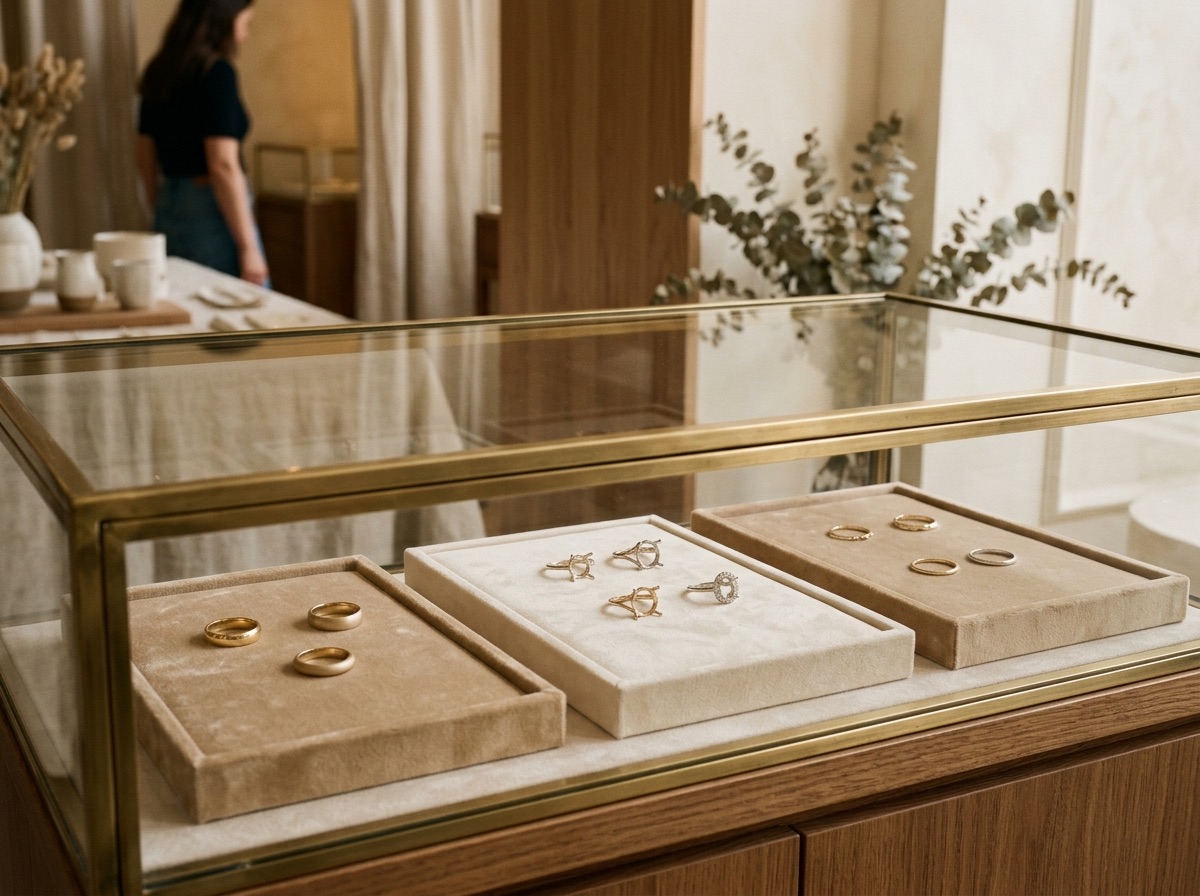
Lab-grown diamonds did something to independent jewelry margins that naturals never did: they made the raw material cost transparent and comparable in a way that used to be nearly impossible for a customer to check. With naturals, opacity around cut, origin, and grading nuance gave every seller room to price differently on stones that looked similar. With lab-grown, a customer can pull up comparable specs on a phone in the store and see a number within seconds.
The instinct is to treat this as bad news for independents. It isn't, if the margin structure shifts along with it. The stone itself is no longer where an independent shop should expect to make its money — that's the commodity bigger players have optimized to sell at thin margin and high volume. The money moves to what they structurally can't deliver: the setting, the customization, the sizing, the service contract, the trade-up relationship.
Practically, this means treating the same 3–5 "hero" specs customers use to anchor price expectations as close to a loss leader, priced within striking distance of the best online price. Everywhere else, price on the full value of the experience, not a race against a filtering tool. Real margin gets made on the setting build, the CAD fee, the sizing and repair menu, and the trade-up program that keeps the same customer's dollars circulating back through the store for a decade.
This also changes how a shop should think about discounting. Reactive across-the-board discounting to match every online price a customer mentions destroys margin on stones that were never actually price-sensitive in the first place, while training the customer to treat every future visit as a negotiation. Disciplined hero-spec pricing does the opposite: it wins the specific comparisons customers actually make, and protects margin everywhere else.
Differentiation strategy: custom design as a competitive moat
Custom design is the single hardest thing for a national retailer to replicate profitably, because it doesn't scale the way a stone-filtering website does. Every custom build is a conversation, a sketch, a round of revisions, and a production timeline that resists automation. That's precisely why it's worth building into a repeatable, well-marketed process rather than treating it as a rare special order.
A workable custom intake process looks like: an initial consultation to understand the idea and the budget, a same-visit or next-day sketch or CAD rendering so the customer leaves with something tangible, a defined revision process (typically one or two rounds before production), and a clear timeline communicated up front. Customers tolerate waiting for something meaningful far more easily than they tolerate vague answers about when it will be ready.
The business case is straightforward: a custom build carries a larger basket size than a stock setting, commands a customization fee that a stock setting sale never generates, and produces a piece the customer is proud enough of to show friends — which is one of the more reliable referral triggers in bridal jewelry. Investing in one salesperson or designer who can sketch or run CAD software, and building a simple before-and-after portfolio of past custom work to show new customers during the consultation, does more for differentiation than almost any other single hire or process change an independent shop can make.
Differentiation strategy: certification transparency and trade-up programs
Certification transparency sounds like table stakes, but very few independents actually use it as a selling tool. Offering both IGI and GIA certification is a start — it removes the friction of a customer who has a preference either way. The bigger opportunity is walking the customer through the actual grading report at the counter: pointing to the clarity plot, explaining what the color grade means in practical terms, showing where the cut grade comes from. A customer who understands their own certificate trusts the purchase more than a customer who was simply handed a PDF after checkout, which is the extent of "transparency" most online retailers offer.
Trade-up and upgrade programs work especially well with lab-grown specifically, because lower entry price points mean many first-time buyers are already planning, consciously or not, to upgrade the center stone down the road — for an anniversary, or simply because they can afford more carat weight than they could at the time of the original purchase. A program where the full purchase price credits toward a larger stone turns that eventual upgrade into a guaranteed second sale for the original store, instead of a sale the customer makes somewhere else entirely.
The mechanics matter: the program needs to be priced into the original margin structure from the start (not treated as a loss when it's finally used), explained clearly at the time of purchase rather than buried in fine print, and honored without friction when a customer actually comes back to use it. A trade-up program a store is proud to explain out loud, in detail, at the counter, is a far stronger sales tool than one that only exists on a receipt.
Inventory strategy for a small store: winning with less, not more
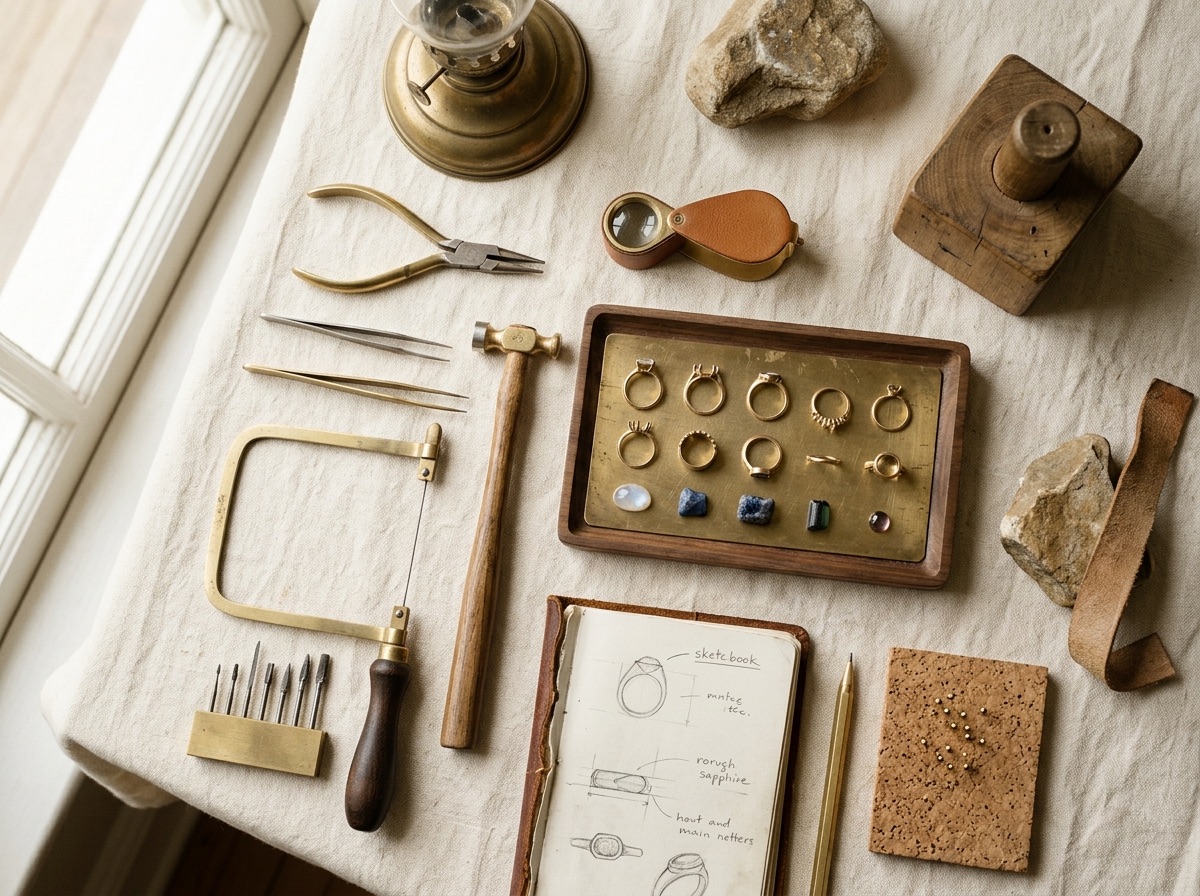
You can't stock 10,000 stones, and trying to compete on raw inventory breadth is a losing strategy for a small shop. You don't need to. Partner with a wholesale supplier who gives you access to thousands of US-held stones that can ship in 24 hours, then present a small, curated selection to each customer that is better than browsing 10,000 online listings alone.
The framing at the counter: "I've pulled five stones for you that match exactly what you described, instead of you sifting through hundreds online. Let's look at them together." The customer experience is higher-value than an unassisted search. The operational cost to the store is lower than carrying deep in-case inventory. And the win ratio on customers who actually walk in is dramatically higher than trying to intercept the same customer online, where they're one tab away from a competitor.
Every month a stone sits in a case unsold is depreciation, insurance cost, and shrinkage risk with nothing to show for it — a cost that used to be easier to absorb when pricing moved more slowly. It doesn't anymore. Just-in-time sourcing is not optional in 2026 for a competitive independent; it's the difference between a healthy balance sheet and capital quietly trapped in a display case.
The practical model: keep a small core assortment of the most-requested specs in-case for walk-in browsing and same-visit closes, and source everything else to order once the customer has committed to a spec. Review the core assortment quarterly and rotate out what hasn't moved. This only works if the wholesale partner behind it can actually ship fast and hold to it consistently — a JIT model built on an unreliable supplier just moves the risk from the display case to the back office.
Marketing an independent shop against bigger players
You cannot out-SEO a national retailer on broad lab-grown search terms, and trying to is a waste of a small marketing budget. You can own local, and local is where a physical storefront actually converts.
- Google Business Profile — complete, with every category filled in, photos updated regularly, Q&A monitored, reviews actively requested from every closed customer, not just the happy walk-ins who mention it unprompted.
- Local schema markup —
JewelryStorestructured data on the store's website, with correct address, hours, and service areas, so search engines understand exactly what the business is and where it operates. - "Near me" and city-specific content — pages targeting "lab-grown diamond engagement rings [city]" and similar searches that a national brand has no reason to build for a market of one town.
- Google Maps optimization — reviews, citations, and local backlinks are the real currency here, more than any single piece of on-page copy.
- Local press and community presence — a feature in a regional magazine or local news segment drives more qualified local bridal traffic than almost any other single tactic available to a shop this size.
- Referral partnerships — formal or informal arrangements with photographers, planners, and venues who see engaged couples before the store ever does.
- Owned customer contact — email or SMS to the existing customer base, timed around anniversaries, cleaning reminders, and trade-up eligibility, rather than one-off promotional blasts.
Bigger players are playing for national search and national brand recognition. Independent jewelers should be playing for local — the one arena where physical presence is an advantage instead of a cost center.
Independent vs. big-box: a side-by-side comparison
No single store wins every row in this comparison, and that's fine — the goal isn't to match every strength a bigger competitor has. It's to make the rows an independent shop actually wins undeniable, and to stop bleeding effort trying to compete on the rows it structurally can't.
| Independent jeweler strength | Big-box / online strength |
|---|---|
| In-person stone comparison under real light | Inventory breadth and instant 4Cs filtering |
| Custom design and same-day CAD renderings | 360-degree video and HDR visual merchandising |
| Local trust, reputation, and referral network | National brand recognition and ad reach |
| Lifetime sizing, cleaning, and repair relationship | Transparent listed pricing, no negotiation |
| Trade-up program tied to an ongoing relationship | 30-day return policies with low buyer risk |
| Curated, consultative selection process | Search and SEO dominance at national scale |
What not to do
Common failure modes for independent jewelers trying to compete with bigger players:
- Disparaging online or big-box retailers. Makes a store look defensive. Plenty of customers have had perfectly positive experiences with online sellers — trashing them insults the customer's own judgment and rarely closes a sale.
- Matching every online price reactively. Destroys margin and quietly trains customers to treat the store as a secondary negotiation stop rather than a first choice.
- Refusing to show lab-grown prominently. Hiding the category because a store prefers selling naturals loses a large share of bridal customers who have already decided on lab-grown before they ever walk in.
- Running outdated inventory photos on the store's own website. Customers check the site before they walk in. If it feels dated, a meaningful share of potential foot traffic is already lost before the door opens.
- Ignoring online reviews. Every Google, Yelp, and Facebook review matters more now than it did five years ago. Reply to each one, including the negative ones, and actively request reviews from every closed customer rather than hoping they think to leave one.
- Treating the custom and service business as an afterthought. These are exactly the categories bigger players can't touch — under-pricing or under-promoting them gives away the store's strongest advantage for free.
What Guru Diam provides

Guru Diam is structured to support exactly this playbook, because the playbook only works if the wholesale relationship behind it actually holds up:
- US-held, same-day shipping wholesale — so the JIT inventory model described above actually works in practice, not just on paper.
- Tariff-paid pricing — so per-carat costs line up with what bigger competitors are paying, instead of an independent shop absorbing a cost disadvantage before the first sale is even made.
- Curated inventory — so sales appointments aren't wasted on stones that arrive looking wrong for the setting or the customer.
- Fancy color and exotic shape access — so a store can differentiate from generic online filters instead of competing on the same round brilliants everyone else sells.
- Trade-account support — including compliant invoice templates, video of every stone, and direct relationships with our NY and LA teams, rather than a support ticket queue.
Open a trade account to see how the wholesale side of the playbook fits your store.
The independent jeweler's action checklist
A working starting point for putting the playbook into practice, section by section:
- Pricing: Identify 3–5 hero specs to price within striking distance of the best online price. Price everything else on full value.
- Wholesale: Confirm the wholesale partner can actually ship fast and consistently, not just on the sales call.
- Inventory: Define a small core in-case assortment; source everything else to order. Review and rotate quarterly.
- Custom design: Build a repeatable intake process — consultation, same-visit sketch or CAD, defined revision rounds, a clear timeline.
- Certification: Offer both IGI and GIA. Build a habit of walking every customer through their own report at the counter.
- Trade-up program: Price it into margin up front, explain it clearly at purchase, and honor it without friction when customers return.
- Local SEO: Complete Google Business Profile, JewelryStore schema markup, city-specific landing pages, active review requests.
- Referral network: Build real relationships with local photographers, planners, and venues — both directions.
- Service menu: Price sizing, cleaning, repair, and appraisals as a real revenue line, not an afterthought.
- Website: Keep inventory photos current. A dated site quietly loses foot traffic before a customer ever calls.
The bottom line
The independent jeweler's playbook isn't about beating bigger players on their own terms. It's about making clear to every walk-in customer that the experience, relationship, service, and curated selection they're getting is worth the small premium — if any — over what they could click and buy from a screen. When a customer stands at the counter, the question they're actually asking is: "Is this worth what I'm paying above the online price?" Run the full playbook — curated inventory, consultative selling, fancies and custom capability, trade-up and service programs, local SEO, confident transparent pricing — and the answer becomes yes for most serious buyers.
The independents who have figured this out in 2026 are doing fine. The ones still trying to compete on per-carat pricing against a multibillion-dollar national retailer are not. The difference is the playbook, not the product.
Frequently Asked Questions
Generally no, not on headline per-carat pricing. But on overall value — including in-person selection, relationship, service, trade-up programs, and curated inventory — independents can absolutely win the sale even at a modest premium over online pricing.
By playing a different game. Own local search, curate a smaller but better inventory, lead with custom and fancy categories, run a real trade-up and service program, and make the in-store experience worth more than the online convenience.
Most independents can close sales at 5–15% above comparable online pricing if the store experience, service offer, and relationship are strong. Above 20% without clear differentiation is difficult.
A baseline e-commerce presence helps — at minimum, letting customers browse a curated selection and request appointments. Running a full online retail channel competing with national giants directly is usually not the best use of an independent's capital.
Refusing to engage with online pricing openly. Customers know online prices exist. Trying to ignore or disparage them breaks trust. Confident, transparent pricing conversations close more sales.
Start with a complete Google Business Profile, structured data markup for your store, local city-specific landing pages, active review management, and steady local PR. This is a months-long effort, not a quick fix.