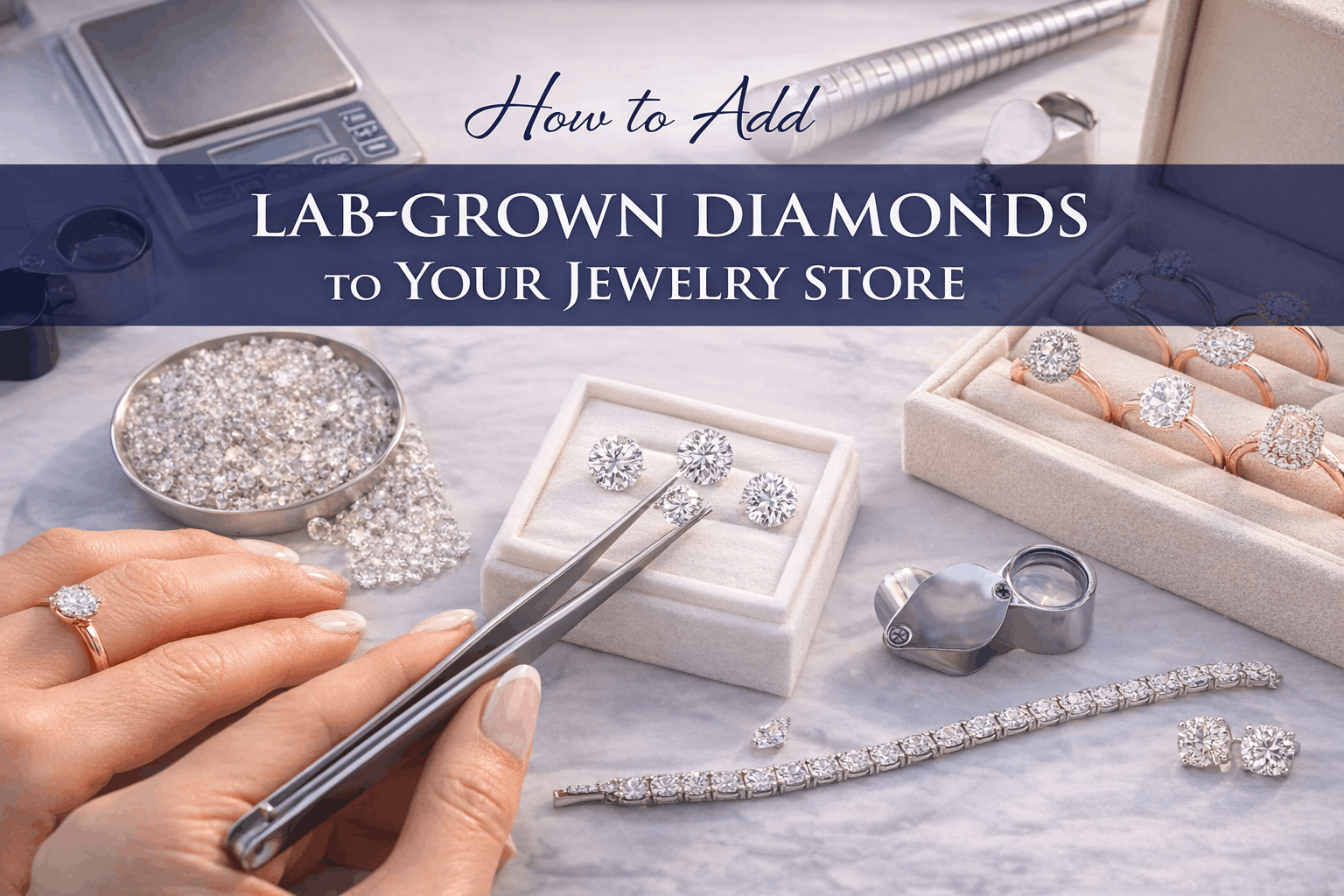
How to Add Lab-Grown Diamonds to Your Jewelry Store: A Retailer's Complete Checklist
If you've been watching the numbers, you already know: lab-grown diamonds for retailers aren't a trend — they're the new baseline. According to BriteCo's 2025 research report, lab-grown diamonds now account for more than 45% of all U.S. engagement ring purchases, up from under 10% just a few years ago. The Knot's 2026 Real Weddings Study found that 61% of couples purchased an engagement ring featuring a lab-created diamond — a 239% increase since 2020.
The question isn't whether to stock lab-grown diamonds. It's how to do it right — so you protect your margins, educate your team, choose the right sourcing model, and meet your customers where they already are. Retailers who treat it as "just another SKU" tend to under-invest in the parts that actually drive sell-through — training and merchandising — and over-invest in the part that doesn't move the needle on its own: simply having stock in a drawer.
This guide walks you through every step, from reading the market correctly to choosing between a standalone case and an integrated one, from memo and consignment options to the launch mistakes that quietly cap first-year sales. Consider it a field-tested checklist from a wholesale partner that ships to retailers across the country every single day.
Why Retailers Are Adding Lab-Grown Diamonds Now
Before placing your first order, ground yourself in the data, because it changes how you make every downstream decision — pricing, staffing, and display space.
The global lab-grown diamond market was valued at $29.46 billion in 2025 and is projected to reach $91.85 billion by 2034, growing at a CAGR of 13.42%, according to Fortune Business Insights. In the U.S. alone, the market is estimated at $21.76 billion in 2025, with North America positioned as the fastest-growing region globally. That's not a niche adjacent category anymore — it's a meaningful share of total diamond jewelry revenue moving through independent retailers, and it's growing while natural-only assortments increasingly plateau.
What's Driving Consumer Demand?
Three forces are converging, and understanding each one changes how you'll merchandise and train around the category:
- Price transparency. By 2025, a 1-carat lab-grown diamond averages $1,000 or less, compared to approximately $4,200 for a natural 1-carat stone. Customers know this before they walk in — they've already compared prices online — and they're choosing bigger, higher-quality stones with the savings rather than simply paying less for the same look.
- Generational shift. Two-thirds of Gen Z engagement ring buyers now choose lab-grown. Millennials are close behind. These aren't fringe buyers — they're your core demographic for the next two decades, and their habits shape how they'll shop for anniversary bands, push presents, and fashion jewelry for years after the first sale.
- Ethical and environmental values. Lab-grown diamonds require no mining, produce minimal waste, and carry no conflict-sourcing concerns. For a growing segment of consumers, this matters as much as the 4Cs, and it's a values conversation your staff should be ready to have honestly rather than deflect.
Beyond demand, there's a margin story that's easy to miss. Because lab-grown wholesale costs are meaningfully lower than natural at comparable size and quality, a well-run lab-grown program can post a healthier gross margin per unit than a comparable natural program — provided you price by value rather than mechanically applying a legacy keystone markup (more on that below). Stores that get pricing right are finding lab-grown isn't just an added category; it's often their highest-margin bridal category, full stop. If your store doesn't carry lab-grown options at all, a significant share of walk-in customers will simply go elsewhere to get it — and they'll take the natural-diamond sale that would have come with it.
Evaluate Your Inventory and Customer Base Before You Buy
Not every store needs the same lab-grown assortment, and the biggest first-order mistake is buying a generic "starter set" instead of one shaped to your actual customer base. Start by asking:
- What are your top-selling price points? Lab-grown diamonds let you offer dramatically larger stones at each price tier. A customer with a $3,000 budget can now consider a 2-carat center stone instead of settling for a smaller natural diamond — which means your existing price-point buckets may need to shift up in carat weight, not just down in price.
- What shapes do your customers request most? Rounds and ovals dominate, but demand for elongated cushions, emeralds, and pear shapes is rising fast. If your store has a reputation for a particular silhouette, lead your lab-grown buy with that shape rather than a generic round-heavy assortment.
- Do you serve a bridal-heavy market, or is fashion jewelry your strength? Lab-grown diamonds are growing fastest in bridal, but non-bridal categories like tennis bracelets and everyday studs are surging as well — and those categories carry a lower average ticket but a faster repeat-purchase cycle.
Map your existing customer profile against the lab-grown opportunity before you write a single purchase order. This mapping exercise — done on paper, not guesswork — is what separates a lab-grown launch that sells through in the first quarter from one that sits in the case for a year.
The Merchandising Decision: Standalone Case or Integrated with Natural
Before you touch pricing or training, you need to decide how lab-grown diamonds will physically live in your store, because this decision shapes everything downstream — how customers discover the category, how staff frame the conversation, and how quickly the assortment turns over.
There are two workable models, and most successful retailers eventually run a hybrid of both:
Option 1: A Dedicated "Lab-Grown Collection" Case
A standalone case gives the category its own identity and its own signage. It makes lab-grown easy to find for customers who already know they want it — a growing share of your traffic, especially among Gen Z and millennial shoppers who researched the category before ever entering your store. A dedicated case also simplifies training: your team can walk a customer through "here's our lab-grown collection" as a clean, self-contained pitch.
The risk: if the case is tucked into a back corner or a secondary sightline, you've signaled — intentionally or not — that lab-grown is a lesser product. Placement matters as much as the decision to have a dedicated case at all.
Option 2: Integrated Directly Into Your Bridal Case
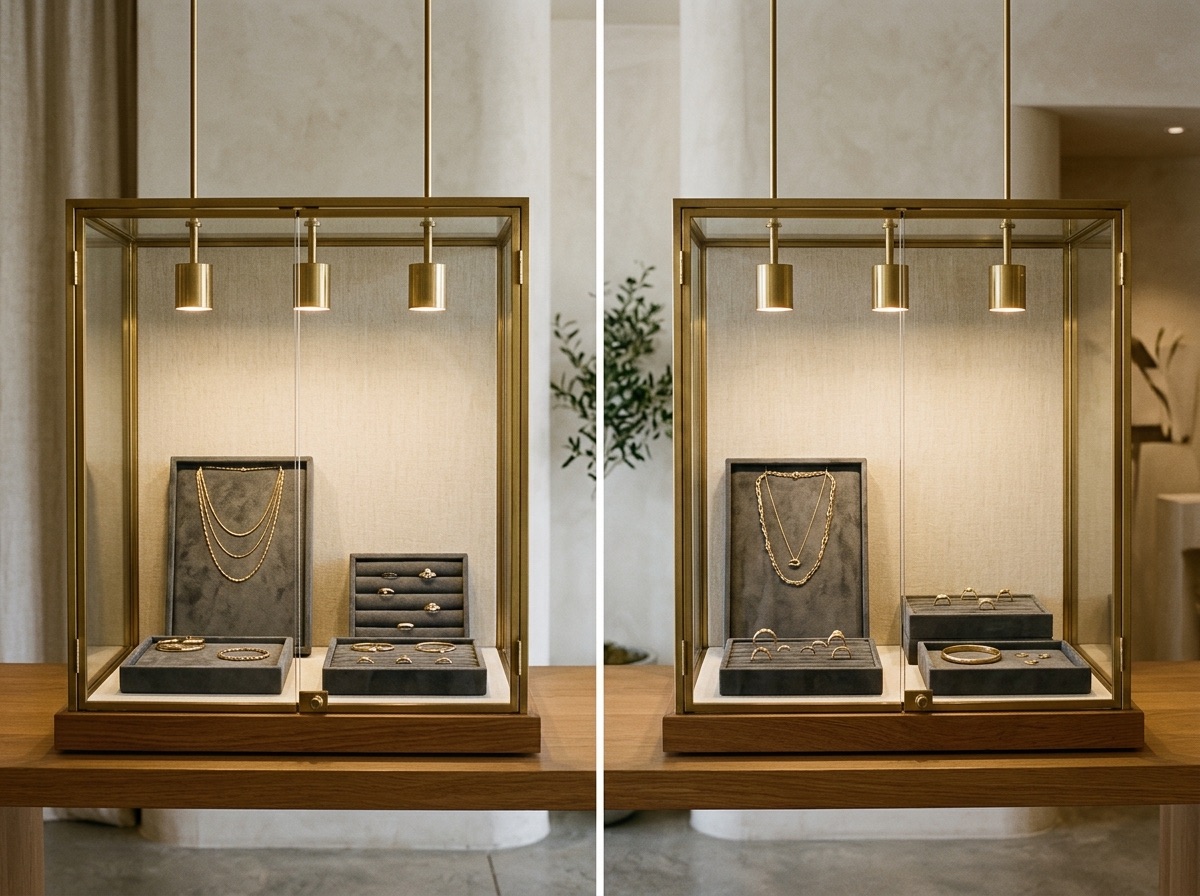
Placing lab-grown pieces alongside naturals in your main bridal case normalizes the category and creates the single most persuasive sales moment available to a retailer: the direct side-by-side comparison. Show a 1-carat natural next to a 2-carat lab-grown at a comparable price point, and let the visual size difference do the selling. This is one of the most powerful merchandising tools in independent retail right now, and it only works if both products share the same case.
The Hybrid Approach — What Most Stores Land On
Keep a dedicated, well-lit "Lab-Grown Collection" section for visibility and discovery, and also place representative lab-grown pieces inside your standard bridal case for direct comparison. This gives you both the category identity of a standalone case and the persuasive power of an integrated one. Whichever layout you choose, use signage that educates rather than defends — a small card explaining "What are lab-grown diamonds?" near the display answers the question before a customer has to ask it, and it should read as factual, not apologetic.

Inventory Models: Buying Outright, Consignment, and Memo
Once you know how you'll display lab-grown diamonds, the next decision is how you'll own them on your books before they sell. Most wholesale suppliers offer some combination of three models, and each carries a different risk and cash-flow profile.
- Outright wholesale purchase. You buy the stones at wholesale price and they're yours — full margin on sale, full risk if they sit. This is the simplest model operationally and the one that gives you the most control over pricing, but it ties up the most capital up front. It tends to work best for the shapes and sizes you already know move well in your market.
- Memo. You take stones on approval for a defined window to show to a specific customer or to test in your case, then return what doesn't sell and pay only for what you keep. Memo is the lowest-risk way to test a new shape, a larger carat weight, or a price point you haven't carried before — use it to validate demand before committing capital to a full buy.
- Consignment. The supplier's stones sit in your case, you carry them at no upfront cost, and you split proceeds or pay wholesale only once a piece sells. Consignment is attractive for expanding breadth without tying up cash, but it requires tight inventory tracking on both sides so nothing gets lost between "in your case" and "sold."
Most retailers use all three at different points in the lab-grown lifecycle: memo to test a new shape, consignment to broaden the case without upfront cost while the category proves itself, and outright purchase once a shape or size range has a proven sell-through rate in your store. Ask any wholesale partner you're evaluating which of these three they actually support in practice — not every supplier offers memo or consignment terms, and the ones that do usually reserve them for established accounts, so ask early in the relationship rather than assuming it's available.
Choosing a Certified, Reliable Wholesale Partner
This is where most retailers either set themselves up for success or create problems they'll spend months fixing. Your wholesale partner determines your margin, your product quality, and — critically — your speed to market.
What to Look for in a Wholesale Lab-Grown Diamond Supplier
Here's what separates a reliable B2B supplier from a risky one:
- Third-party certification on every stone. Every stone should come with IGI or GIA certification. No exceptions. Certification gives your customers confidence and protects you from quality disputes.
- Breadth of inventory. A supplier with a few hundred stones will leave you scrambling when a customer wants something specific. Look for partners carrying thousands of certified diamonds across a wide range of sizes, shapes, and qualities.
- Rare and specialty shapes. Consumer taste is diversifying. Having access to antique cuts — Old Mine, Old European, Hexagon — gives you a merchandising edge that big-box competitors can't match.
- Speed. In retail, every day a customer waits is a day they might buy elsewhere. Same-day shipping capability is a genuine competitive advantage, especially when a customer is standing in front of your team asking "how soon can I have it."
- Technology integration. If your supplier offers API integration or CSV inventory downloads, you can sync their stock directly to your website or POS system — no manual data entry, no stale listings.
- Flexible terms as your volume grows. A supplier who can move you from memo to consignment to a standing wholesale account as your program matures is a better long-term partner than one offering a single rigid arrangement.
Guru Diam, for example, maintains an inventory of 11,000+ IGI and GIA certified lab-grown diamonds across 30+ shapes — including rare antique cuts — with same-day shipping from their New York office. Their API integration and CSV download tools let retailers connect inventory directly to their own platforms, which is the kind of infrastructure that saves hours every week.
Certification Practices to Require, Every Time
Certification isn't a box to check once — it's a standard you should enforce on every single stone that enters your case. At minimum, require:
- A full grading report, not a summary card. The report should state cut, color, clarity, and carat weight individually, along with a clear statement that the stone is laboratory-grown. A supplier who can't produce the full report on request is not a supplier to build a program on.
- A recognized lab. IGI and GIA are the two labs your customers will recognize and trust. If a supplier offers stones from an unfamiliar or in-house lab at a discount, treat that discount as a red flag, not a bargain — your customer's confidence rests on a name they can verify independently.
- Report-to-stone matching at intake. Before a stone goes into your case, confirm the report number, measurements, and inscription (if laser-inscribed) match the physical stone. This takes minutes and prevents a dispute from ever reaching a customer.
- Consistent grading standards across your supplier's catalog. Ask how the supplier's internal QC compares to lab grading — a supplier that grades tightly to the certificate, rather than optimistically, is one whose stock you can sell with confidence sight-unseen.
Comparison: Wholesale Account, Marketplace, and Direct Sourcing
Retailers generally source lab-grown inventory through one of three channels. Each has a real trade-off, and most established stores end up leaning on one primary channel while keeping a second open for gaps.
| Sourcing Model | Pricing | Inventory Depth | Relationship & Support | Best For |
|---|---|---|---|---|
| Wholesale account (direct with a B2B supplier) | True wholesale, negotiable at volume | Deep in a supplier's specialty; consistent stock on reorders | Dedicated rep, memo/consignment terms possible, custom manufacturing access | Stores building a standing, repeatable lab-grown program |
| B2B marketplace (multi-vendor platform) | Competitive but variable by listing vendor | Very broad across vendors, inconsistent within any one vendor | Transactional; support varies vendor to vendor | One-off sourcing of a specific stone a regular partner doesn't carry |
| Direct import/cutter relationship | Lowest per-stone cost at high volume | Narrow unless you manage multiple relationships | Minimal hand-holding; you own quality control and logistics | High-volume buyers with in-house grading expertise |
For most independent and regional retailers, a standing wholesale account with one primary B2B supplier — supplemented by a marketplace search when a customer requests something genuinely unusual — is the combination that balances margin, reliability, and the support needed to actually launch and grow the category, rather than just stock it.
Pricing and Markup Strategy for Lab-Grown Diamonds
Pricing lab-grown diamonds is different from pricing naturals. The market moves faster, wholesale prices can shift, and your customers are often well-researched before they walk in the door.
Pricing Principles for Lab-Grown Diamonds
- Don't anchor to natural diamond markups. Lab-grown diamonds have a different cost structure. Applying the same keystone markup you'd use for naturals can price you out of the market — or, conversely, leave margin on the table.
- Price by value, not just cost. Customers are buying the look, the certification, and the story. A well-presented 2-carat IGI-certified lab-grown diamond in a custom setting commands a strong price, even at a fraction of the natural equivalent.
- Bundle strategically. Lab-grown diamonds pair naturally with custom settings. Offer setting + stone packages at attractive price points to increase your average order value.
- Monitor the wholesale market. Because lab-grown diamond pricing has seen downward movement over recent years, staying close to your supplier's current pricing ensures your retail pricing stays competitive. A supplier with a real-time online inventory — rather than static price lists — helps you stay current.
- Reprice on a schedule, not on instinct. Set a recurring calendar check — monthly is typical — to compare your posted retail prices against current wholesale cost. Lab-grown cost curves move faster than natural, and a price list you set at launch can drift out of step with the market within a single quarter.
Training Your Sales Team on Disclosure and Positioning
Your staff are the bridge between the product and the customer. If they can't confidently explain lab-grown diamonds, hesitation will kill sales — and hesitation from a salesperson reads to a customer as something being wrong with the product.
Key Training Topics
- The science, explained plainly. Lab-grown diamonds are real diamonds — chemically, physically, and optically identical to mined stones. Guru Diam's lab-grown catalog is grown using Chemical Vapor Deposition (CVD), a controlled process that builds a diamond crystal layer by layer under carefully managed conditions. Your team should be able to explain this in one or two plain sentences without sounding like they're reading from a textbook.
- Certification literacy. Every staff member should be able to read an IGI or GIA lab-grown diamond report and explain the 4Cs — cut, color, clarity, and carat weight — to a customer. This builds trust instantly, and it's the single fastest way to defuse skepticism.
- Disclosure, as a legal and trust requirement. FTC guidelines require that lab-grown diamonds be clearly and conspicuously identified as such at the point of sale — on tags, in signage, and in any advertising. This isn't optional fine print; treat disclosure as a trust-building feature of your pitch, not a compliance chore to minimize. Customers respond well to a retailer who leads with clarity rather than one who makes them hunt for the distinction.
- The value conversation. Train your team to present lab-grown diamonds as a choice, not a compromise. The data supports this: consumers are using the savings to buy larger, higher-quality stones. According to BriteCo data, the average lab-grown engagement ring center diamond increased from 1.31 carats in 2019 to 2.45 carats in 2025.
- Handling objections. "Will it hold its value?" "Is it a real diamond?" "What's the difference?" Your team needs rehearsed, honest answers to these questions. Transparency builds loyalty, and an evasive answer costs you more trust than an honest one ever would.
- Side-by-side presentation, without steering. If you carry both natural and lab-grown, teach your staff to present both options evenhandedly. Let the customer's priorities — budget, size, ethics, sentiment — guide the recommendation, rather than staff preference or which category happens to be easier to talk about.
Run this training as a live session with real stones and real certificates in the room, not a slideshow. Staff retain the certification-reading skill and the objection-handling language far better when they've practiced holding a loupe to an actual report than when they've only heard it described.
Extend Your Presence Online
Your in-store merchandising decision only covers foot traffic. Your website needs to reflect the same commitment, since most customers now research lab-grown diamonds before they ever walk in.
At minimum:
- Add a lab-grown diamond category page with filters for shape, size, color, and certification.
- Include educational content — a landing page explaining what lab-grown diamonds are, how they're certified, and why you carry them.
- If your supplier offers API or CSV integration, use it. Displaying real-time inventory from a partner like Guru Diam means your online catalog can feature thousands of stones without you carrying all of them in-house.
Common Mistakes Retailers Make When Launching Lab-Grown
Most launch problems aren't about the product — they're about process. Watch for these:
- Buying a generic assortment instead of one shaped to your customer base. A round-heavy, mid-carat buy might sell fine at the mall down the street and sit untouched in a store known for fancy shapes and bridal customization. Go back to the inventory-mapping step before you place a large first order.
- Treating disclosure as an afterthought. Retailers who bury the lab-grown label in small print, or train staff to avoid the word, create the exact skepticism they're trying to prevent. Customers who feel misled — even briefly — rarely come back.
- Under-training staff and over-relying on signage. A sign can answer a simple question; it can't handle an objection or close a sale. Skipping live training and hoping a display card will do the selling is the single most common reason a lab-grown launch underperforms in year one.
- Pricing on autopilot. Carrying over a natural-diamond keystone markup without adjusting for lab-grown's different and faster-moving cost structure either prices you out of the market or leaves margin on the table — sometimes both, at different price points in the same case.
- Choosing a single sourcing channel and never revisiting it. A supplier that was the right fit at launch may not have the depth you need once the category takes off. Revisit your sourcing mix (wholesale account, marketplace, memo, consignment) as your volume grows, not just once at the start.
- No reorder rhythm. Without a scheduled review of sell-through data, it's easy to let a slow-moving shape sit in the case for months while a fast-moving one goes unreordered until it's already sold out.
How Guru Diam Supports Your Launch
Every step in this guide — sourcing, certification, pricing, training, merchandising — depends on having a wholesale partner built to support it, not just sell you stones and move on.
Guru Diam maintains an inventory of 11,000+ IGI and GIA certified lab-grown diamonds across 30+ shapes — including rare antique cuts like Old Mine, Old European, and Hexagon — with same-day shipping from their New York office. Their API integration and CSV download tools let retailers connect inventory directly to their own platforms, syncing stock without manual data entry or stale listings.
For retailers pairing lab-grown diamonds with custom jewelry to maximize margin, Guru Diam provides custom jewelry manufacturing in 7–10 days — a one-of-a-kind piece for your customer without the multi-week wait that frustrates buyers. Custom pieces carry higher margins than pre-set inventory and create the kind of emotional attachment that drives referrals.
Whether you're adding your first lab-grown tray or scaling an existing program, Guru Diam is built to support retailers at every stage — from a first memo order to a standing wholesale account with custom manufacturing built in.
Build Your Marketing Around the Category
Once you've stocked and trained, tell people about it.
- Update your Google Business Profile to include "lab-grown diamonds" in your product descriptions.
- Run targeted social ads featuring lab-grown engagement rings with clear price-point messaging. Size comparisons perform especially well.
- Send an email campaign to your existing customer list announcing the new collection. Frame it as expanding choice, not replacing anything.
- Create blog and video content explaining your lab-grown offerings. Educational content ranks well in search and positions your store as a knowledgeable destination.
- Leverage your supplier's resources. Some B2B wholesalers offer marketing assets, product photography, and inventory feeds that make content creation easier.
Your Complete Retailer's Checklist
Here's every step in one place — print this out and work through it:
- Research the market — understand lab-grown diamond growth trends, pricing, and your local competitive landscape.
- Audit your current inventory — identify gaps where lab-grown diamonds would serve existing customer demand.
- Decide on your merchandising model — standalone case, integrated with natural, or a hybrid of both.
- Choose your inventory model — outright purchase, memo, or consignment, based on how much risk you want to carry at launch.
- Choose a certified wholesale partner — prioritize IGI/GIA certification, broad inventory, rare shapes, fast shipping, and tech integration.
- Request wholesale access — apply through your supplier's B2B platform to unlock retailer pricing and tools.
- Set your pricing strategy — establish markups based on current wholesale pricing, not legacy natural-diamond margins.
- Train your entire sales team — cover the science, certification, disclosure requirements, value positioning, and objection handling.
- Update your store displays — create well-lit, clearly signed lab-grown sections and integrate pieces into your bridal case.
- Build your online presence — add lab-grown diamond pages, educational content, and live inventory feeds to your website.
- Offer custom jewelry services — partner with a manufacturer who can deliver custom pieces on a fast, reliable turnaround.
- Launch your marketing — update your Google profile, run social ads, send email announcements, and create educational content.
- Establish a reorder rhythm — review sell-through data monthly and adjust your assortment based on what moves.
- Stay connected to your supplier — join inventory broadcast channels (like WhatsApp updates) and keep communication lines open for trend insights and new arrivals.
Frequently Asked Questions
What certifications should lab-grown diamonds have?
Every lab-grown diamond you sell should carry certification from a recognized independent gemological laboratory — most commonly the International Gemological Institute (IGI) or the Gemological Institute of America (GIA). These certifications verify the diamond's 4Cs (cut, color, clarity, and carat weight) and confirm it is laboratory-grown. Certified stones build customer confidence and protect your store's reputation.
How much cheaper are lab-grown diamonds compared to natural diamonds?
Lab-grown diamonds are typically 70–80% less expensive than comparable natural diamonds. As of 2025, a 1-carat lab-grown diamond averages $1,000 or less at retail, compared to approximately $4,200 for a natural 1-carat diamond. This price advantage allows your customers to purchase significantly larger or higher-quality stones within the same budget.
Should I use a standalone lab-grown case or integrate it with my natural diamonds?
Most successful retailers land on a hybrid: a dedicated, well-lit "Lab-Grown Collection" display for visibility and discovery, plus representative lab-grown pieces placed directly alongside naturals in the bridal case for side-by-side size comparison. A standalone case alone risks under-signaling the category if it's placed poorly; integration alone can undersell the category's own identity. Running both gives you the benefits of each.
Should I buy outright, memo, or consign my lab-grown inventory?
It depends on how much risk you want to carry while the category is new to your store. Memo lets you test a shape or price point with no ownership commitment; consignment lets you broaden your case without tying up capital; outright purchase gives you full margin and control once you know what sells. Most retailers use all three at different points — memo to test, consignment to expand, and outright purchase for proven performers.
How do I explain lab-grown diamonds to customers who are skeptical?
Be transparent and factual. Lab-grown diamonds are chemically, physically, and optically identical to mined diamonds — they are real diamonds. They're graded using the same 4Cs criteria and certified by the same laboratories. The primary differences are origin (laboratory vs. earth) and price. Most skepticism dissolves when customers see certification side-by-side and understand that even gemological experts cannot distinguish them without specialized equipment.
How do I find a reliable wholesale lab-grown diamond supplier?
Look for a B2B wholesale supplier that offers third-party certified diamonds (IGI or GIA), a large and diverse inventory, rare and specialty shapes, same-day shipping, and technology tools like API integration for seamless inventory syncing. Guru Diam, headquartered at 36 West 47th Street in New York City with a second office at 607 S Hill Street in Los Angeles, offers all of these features with 11,000+ certified diamonds and custom jewelry manufacturing — making them a strong partner for retailers entering the lab-grown category. Visit gurudiam.com to request wholesale access.
Ready to Stock Your Store?
Ready to stock your store with certified lab-grown diamonds? Guru Diam makes it easy — 11,000+ IGI and GIA certified stones, 30+ shapes including rare antique cuts, same-day shipping from New York, and custom jewelry manufacturing in 7–10 days. Whether you're adding your first lab-grown tray or scaling an existing program, we're the wholesale partner built to help retailers grow.
Request Wholesale Access at gurudiam.com →
You can also reach us directly via WhatsApp for real-time inventory updates, or visit us in person at our New York or Los Angeles offices.
Related Articles
- Lozenge Diamonds Wholesale Guide — calibrated elongated side stones for Art Deco-style settings.
- Coffin Cut Diamonds Wholesale Guide — the antique tapered step cut for Art Deco-style rings.
- Octagon Cut Diamonds Wholesale Guide — an eight-sided step cut with fully faceted truncated corners.