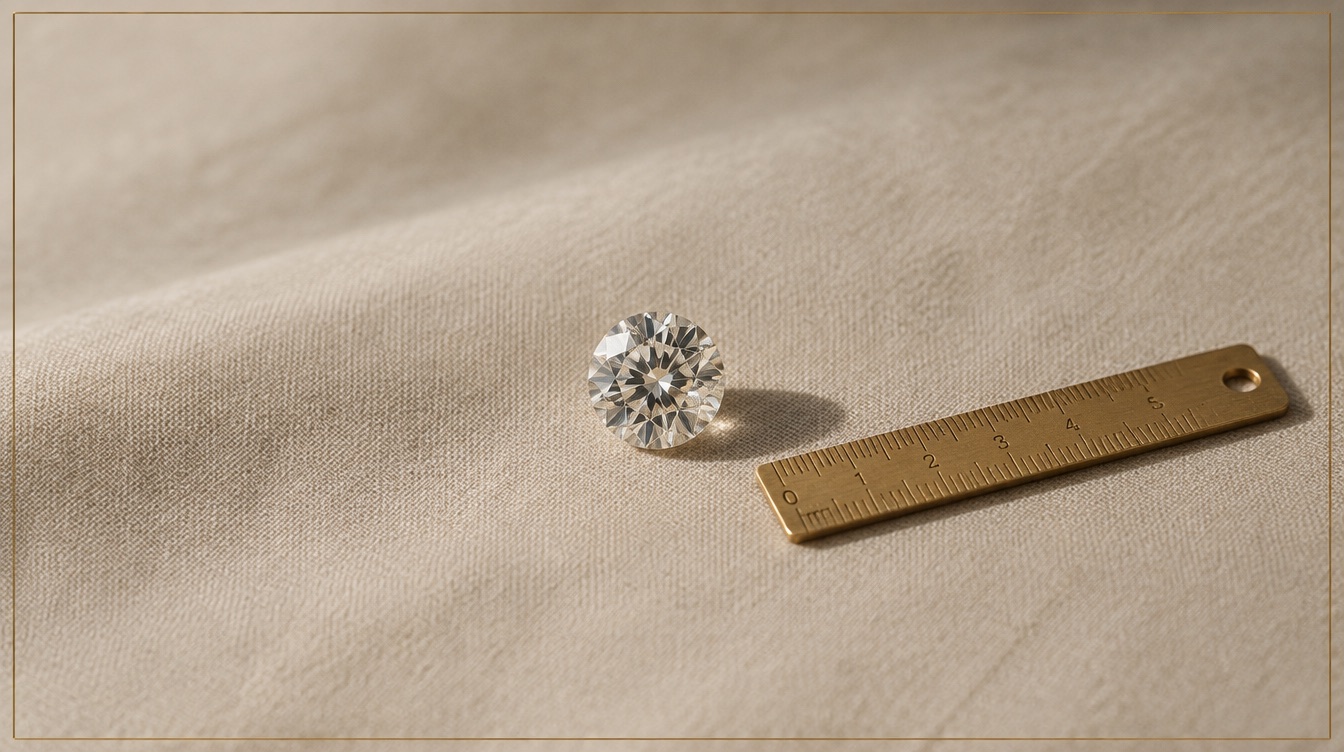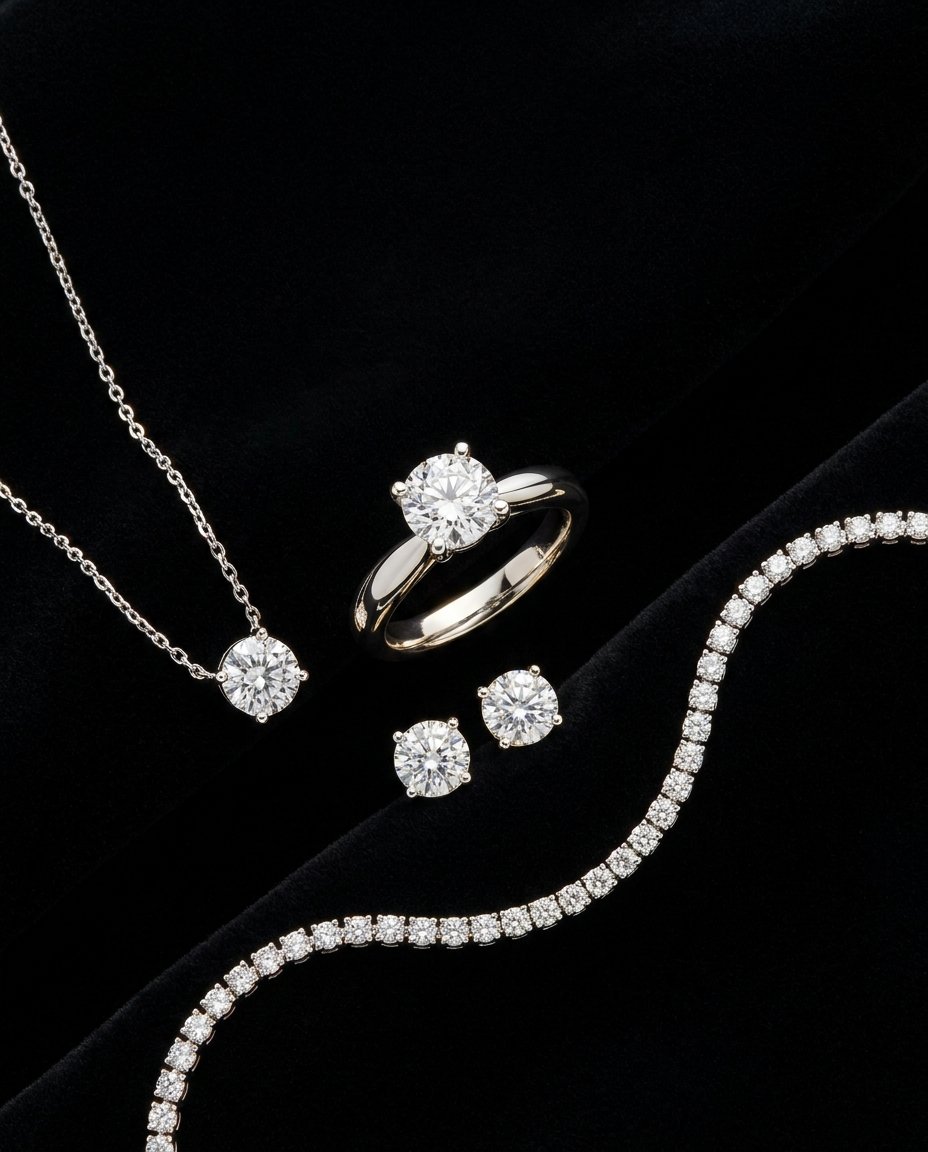
How Independent Jewelers Can Offer Custom Diamond Jewelry Without a Bench

Custom diamond jewelry for jewelers without a bench is fully achievable: partner with a wholesale supplier running an outsourced custom studio. You sell the design and capture the margin while the supplier sources the certified center stone and matched accents, produces the CAD-to-finished piece, and ships it ready to deliver. No equipment, no payroll, no minimum order.
For most independents, custom is the highest-margin work on the counter and the hardest to staff. A skilled bench jeweler is a six-figure hire who needs steady volume to justify the cost, plus a casting setup, a stone inventory deep enough to match a client's spec on demand, and a CAD operator who can turn a sketch into a renderable file. Few single-door stores can carry all of that and keep it busy. The result is that custom requests either get turned away, get sent to a slow trade shop with a three-week turnaround, or get quoted so cautiously that the client walks.
There is a cleaner way to run it. Treat custom as a sourcing-and-fulfillment problem, not a manufacturing problem, and outsource the parts that require capital and specialized labor. This guide breaks down what custom actually costs to run in-house, what an outsourced custom studio replaces, the spec and timeline you can promise a client, and the talk track to close the sale at the counter.
Why is custom the highest-AOV work an independent can sell?
Custom is where margin lives. A loose certified stone is a commodity the client can price-check in seconds; a finished, personalized piece is not. When a customer co-designs a ring, the comparison shopping stops, the conversation moves off price, and the order value climbs. Personalization consistently lifts average order value across retail — research from Deloitte Digital shows consumers will pay materially more for products they help shape, and that the emotional buy-in around a custom piece reduces price sensitivity and returns.
The demand backdrop favors it, too. Vintage and antique-inspired engagement styles have surged in 2024–2026, with The Knot's engagement ring trends reporting a clear shift toward distinctive, personal, non-generic designs — Old Mine and Old European cuts, bezels, toi-et-moi settings, fancy shapes, and colored center stones. Those are exactly the requests a standard mass-produced case can't fill, and exactly what custom is for. If your store can say "yes, we can build that" instead of "we only carry what's in the case," you capture a buyer who would otherwise leave for a designer or an online custom house.
The catch is execution speed. A vintage-inspired three-stone with a fancy-shape center and matched trapezoid sides is a sourcing puzzle most independents cannot solve in-house fast enough to keep the client's momentum. That is the gap an outsourced studio fills.
What does running custom in-house actually cost?
Before you decide custom isn't worth it, price out what doing it yourself requires. The honest accounting usually surprises owners — the bench salary is only the first line.
| Capability | In-house cost / burden | Outsourced custom studio |
|---|---|---|
| Bench jeweler / goldsmith | $60k–$120k+ salary, needs steady volume | Included in per-piece price |
| CAD designer / operator | Salary or per-file outsourcing, software licenses | Included; CAD + render provided for approval |
| Casting & finishing equipment | $15k–$50k+ capital, plus maintenance | None |
| Center-stone inventory depth | Tens of thousands in slow-turning stock to match any spec | Drawn from 11,000+ certified stones on demand, no MOQ |
| Matched accent / melee sourcing | Hard to source side stones and calibrated melee fast | Matched pairs and calibrated melee under one roof |
| Turnaround risk | 2–4 weeks typical when juggling other repair work | 4–6 day custom turnaround |
| Failed-job / rework exposure | You eat the loss on a botched setting | Supplier absorbs production risk |
The deeper problem isn't any single line — it's that all of them have to be funded and kept busy simultaneously. A bench that sits idle three days a week is still a full salary. Inventory deep enough to match any spec on demand is dead capital most of the year. Outsourcing converts every one of those fixed costs into a variable, per-piece cost you only pay when you've already made the sale.
What does an outsourced custom studio actually do for you?
An outsourced custom studio is a wholesale partner that owns the stones, the CAD, and the production, and hands you a finished piece to sell. The division of labor is clean: you own the client relationship and the retail margin; the supplier owns the capital-intensive back end.
Here is the workflow Guru Diam runs for trade partners, start to finish:
- Spec intake. You send the client's brief — center stone shape and size, metal, setting style, finger size, reference images. A sketch or a screenshot is enough to start.
- Stone sourcing. The center stone is pulled from live inventory of IGI/GIA certified loose diamonds, with HD video and 360 so you and your client see the exact stone before commitment. Need a fancy shape, a fancy color, or an antique cut like Old Mine or Old European? They're in stock, not back-ordered.
- Accent and melee matching. Side stones, matched fancy-shape pairs, and calibrated melee for pavé or halos are sourced from the same house — no second vendor, no color or size mismatch between the center and the accents.
- CAD and render. You receive a CAD render to approve with your client before anything is cast. Changes happen on the screen, not on the bench.
- Production. Cast, set, and finished in 4–6 days, versus the 9–19 days that is typical when work routes through multiple subcontractors.
- Ship. Same-day shipping from NY or LA on the finished piece, ready for your client.
The single most important word in that list is matched. The reason a vintage three-stone or a fancy-color halo fails in-house isn't the center stone — it's that the accents don't agree with it. Sourcing a fancy-shape center and its trapezoid or epaulette sides from one supplier who can hold them to a tight tolerance is the difference between a piece that looks intentional and one that looks assembled. That is why "all under one roof" matters more for custom than for any other category.
What spec and tolerance can I promise a client on a custom build?
A jeweler quoting custom needs to know the matching tolerances cold, because the client will ask whether the side stones "really match." Here is the trade-grade answer, and the standards behind it.
| Element | Working tolerance | Why it matters |
|---|---|---|
| Calibrated melee size | ± 0.05–0.10 mm | Keeps pavé and channel-set rows even; gaps and bridging show at this scale |
| Matched pair size | within ± 0.1–0.2 mm | Side stones read as a true pair to the naked eye |
| Matched pair color | within ~1 grade | A two-grade gap reads as a visible mismatch next to the center |
| Cut & symmetry on pairs | mirror-matched, paramount | Symmetry mismatch is more noticeable than a slight size difference |
| Melee size threshold | under 0.20 ct (~3.8 mm) | GIA defines melee as full- or single-cut stones below one-fifth carat |
Those are the numbers that let you tell a client, with a straight face, that the accents are matched to spec rather than "close enough." When the center is a fancy color, the genesis of the color is worth knowing too: nitrogen produces yellow, boron produces blue, and lab-grown pink is achieved through post-growth treatment applied to CVD-grown material — so a matched fancy-color set has to be sourced together to read consistently. On the grading side, IGI grades the large majority of lab-grown with full 4Cs and is the trade default, while GIA moved lab-grown to a two-tier Premium/Standard descriptive system in late 2025 — so confirm which report a fancy-color stone carries before you quote. A supplier that screens its melee and holds calibration tolerance is doing the QA your bench would otherwise have to do.
One more spec note your client cares about: cost. Lab-grown wholesale prices fell roughly 26% in 2025 and are now stabilizing, per Edahn Golan's index, with quarter-on-quarter declines shrinking to the smallest on record. That means a lab-grown custom build today lands at a price point that was impossible two years ago — you can offer a larger or higher-color center inside the same budget, which is itself a closing tool.

How do I close custom at the counter without overpromising?
The risk with custom is the gap between what you promise and what you can deliver. Outsourcing closes that gap because you are quoting against a real, in-stock stone and a fixed turnaround, not a hope. Here is a talk track you can reuse with your own clients:
"I can build exactly what you're describing. Let me pull the center stone — I'll show you the actual diamond on video and its certificate before you commit to anything. The side stones will be matched to it, not just similar. You'll see a 3D render of the finished ring to approve, and once you sign off it's about a week to your hands. Nothing gets made until you've seen it."
Every clause in that script is backed by the outsourced workflow: live stone video, IGI/GIA certs, matched accents, CAD approval, 4–6 day turnaround. You are not bluffing. The client hears "custom" and "fast" and "I get to see it first" — three things that close the sale and kill the urge to shop online.
Ready to add custom to your store without hiring a bench or carrying setting inventory? Request a wholesale account to get verified trade access to live pricing, the full certified-stone inventory, and the custom desk.
How does outsourced custom protect my margin against 2026 tariffs?
Tariff exposure is the quiet reason to keep custom sourcing flexible in 2026. Under the proposed U.S.–India trade framework, treatment splits sharply by category: loose natural diamonds and colored gemstones are slated to move toward 0% duty, while finished jewelry, cultured pearls, and lab-grown diamonds are framed to carry roughly an 18% tariff, per JCK's reporting on the deal and National Jeweler's coverage of the negotiations. This framework is still proposed and evolving, so treat exact rates as moving targets — but the structural lesson holds.
The takeaway for custom: where the piece is finished, and on what stones, changes your landed cost. A supplier holding U.S.-based inventory in NY and LA and producing domestically gives you a hedge against import-finished jewelry duties and a faster lane than re-importing a finished piece from overseas. If you want to think through inventory positioning against the proposed rates, our 2026 tariff and inventory hedge guide for jewelers walks through the scenarios. For custom specifically, the flexible-sourcing point is the one that matters: when you don't own the inventory, you don't carry the tariff risk on stock that may never sell.
What should I ask before choosing an outsourced custom partner?
Not every wholesale supplier that offers “custom” runs the same program. Before you commit a client's order — and your reputation — to a new partner, run them through a short diligence checklist:
- Can you verify the center stone independently? A legitimate supplier gives you the certificate number before you commit, so you can look the report up directly on the issuing lab's own site (IGI or GIA) rather than trusting a PDF. If a supplier won't share the cert number up front, that is a real red flag.
- Do you see the actual stone, not a stock photo? HD video or a 360° view of the specific stone your client will get — not a generic representative image — is the standard to hold any custom partner to.
- Is there a CAD approval step before anything is cast? You and your client should sign off on a render before metal gets touched. A partner who casts first and shows you after is asking you to sell blind.
- Who owns a mismatch or a production error? Ask directly what happens if a side stone doesn't match spec, or a setting comes back flawed. A partner confident in their process will have a clear answer; a vague one is a warning sign.
- What is the actual, current turnaround — not just the marketing number? Ask what today's queue looks like, not only the advertised range, especially heading into a bridal season or a trade show.
- Does the piece ship branded or unbranded? Confirm this explicitly and in writing before your first order, not after a client notices a mark on their ring.
None of these questions are unusual to ask a vendor you are about to build your custom program around. A supplier that answers all six without hesitation is one worth a trial order; one that dodges two or more is worth a second opinion before you route a client's ring through them.
How is this different from just buying loose and finding my own bench?
You can absolutely buy a loose stone wholesale and route it to an independent bench — and for a jeweler who already has a trusted goldsmith and steady custom volume, that's a fine model. The outsourced studio is for the store that doesn't, or whose bench is buried in repairs. The difference is integration: when the center stone, the matched accents, the CAD, and the production all live under one roof, the failure points between vendors disappear. No "the side stones came back two grades off." No "the caster cracked the seat and now we're three weeks behind." No reconciling a melee parcel from one supplier against a center from another. One spec in, one finished piece out, one accountable partner. That is what makes a no-MOQ custom program runnable for a single-door independent.
Will the finished piece be branded as Guru Diam, or can I resell it as my own?
This is usually the first question an owner asks once the sourcing question is settled, and it deserves a direct answer: outsourced custom only works for your business if the piece leaves the studio ready to be yours.
Custom rings built through Guru Diam's trade program ship unbranded by default. No maker's mark, no hallmark referencing the supplier, nothing on the certificate paperwork that points a client back to where the piece was actually produced. You hand your client a ring, a box, and a certificate that reads as a piece your store built for them — because from the client's perspective, that is exactly what happened. You managed the design conversation, approved the CAD, and delivered the finished result.
This matters more for custom than for any other wholesale category, because custom is precisely the work where a client is paying for a relationship with your store, not just a stone. A visible third-party mark on a bespoke engagement ring undercuts the entire premise of the sale — the client came to you because they wanted something made for them, not something assembled by an anonymous factory and handed off through a middleman. White-label production keeps that story intact.
Practically, that means your quote to the client, your paperwork, and your after-sale service — resizing, cleaning, warranty conversations — all stay in-house at your counter. The supplier relationship is invisible to the end customer by design.
This also protects you against a subtler risk: a client who later researches their ring online and stumbles onto the production source. Unbranded fulfillment means there is no stamped logo, no public listing, and no paperwork trail pointing away from your store — the same standard a private-label manufacturer would hold itself to in any other retail category.
Frequently Asked Questions
Can a jeweler offer custom diamond jewelry without an in-house bench?
Yes. By partnering with a wholesale supplier that runs an outsourced custom studio, an independent jeweler sells the design and keeps the retail margin while the supplier sources the certified center stone and matched accents, produces the CAD-to-finished piece, and ships it ready to deliver. No bench jeweler, casting equipment, or stone inventory is required on your side.
Is there a minimum order quantity for outsourced custom work?
No. Guru Diam runs custom with no MOQ, so an independent can order a single finished piece against a single client's spec. You only pay the per-piece cost once you have already made the sale, which converts the fixed costs of an in-house bench into a variable cost.
How fast can an outsourced custom diamond piece be produced?
Guru Diam completes custom builds in 4–6 days from approved CAD, versus the 9–19 days that is typical when a job routes through multiple subcontractors. Stones ship same-day from NY or LA, so the only meaningful clock is production and your client's approval of the render.
How do I know the side stones will match the center stone?
Because the center, the matched pairs, and the calibrated melee are sourced from one house, accents are held to trade tolerances — typically within ±0.1–0.2 mm in size and within about one color grade for matched pairs, and ±0.05–0.10 mm for calibrated melee — with cut symmetry treated as paramount. That single-supplier integration is what prevents the color and size mismatches that plague multi-vendor custom.
Do I need to be a verified trade buyer to use the custom studio?
Yes. Guru Diam is a B2B wholesale supplier serving verified jewelers, retailers, designers, and manufacturers only — not consumers. Live wholesale pricing, the full certified-stone inventory, and the custom desk unlock after you request a wholesale account and your trade credentials are verified.
Will 2026 diamond tariffs affect my custom orders?
Possibly, depending on how the proposed U.S.–India framework finalizes. Current proposals point toward roughly 0% duty on loose natural diamonds and around 18% on finished jewelry and lab-grown goods, but rates are still evolving. Sourcing from a supplier with U.S.-based NY and LA inventory and domestic production gives you a hedge, and because you don't own the inventory in an outsourced model, you don't carry tariff risk on unsold stock.
Will the finished custom piece be branded with the supplier's name?
No. Custom rings built through Guru Diam ship unbranded by default, with no maker's mark or supplier reference on the piece or its paperwork, so you can present and sell it as a piece your own store produced.
What should I ask a wholesale custom partner before committing a client's order?
Confirm you can independently verify the center stone's certificate with the issuing lab, that you'll see real video or 360-degree imagery of the actual stone, that CAD approval happens before casting, how mismatches or production errors are handled, current (not just advertised) turnaround, and whether the piece ships branded or unbranded.
Can I put my own store's hallmark or stamp on a piece built through the custom studio?
Yes. Because the piece ships unbranded, your store's own hallmark, stamp, or engraving can be applied exactly as it would be on any piece produced in-house. Nothing about the outsourced production changes what you're able to mark or represent the piece as.
Custom is the margin work most independents leave on the table because the in-house economics don't add up. They don't have to. Outsource the bench, the CAD, the inventory, and the production to a single accountable wholesale partner, and you keep the client and the margin while shedding the overhead. Request a wholesale account to unlock live pricing and the full certified-stone inventory, or book an appointment with the trade desk at our New York and Los Angeles desks to walk through your first custom build start to finish.