Two stones can carry the same certificate, the same shape, the same carat weight, and the same color and clarity grade — and still sell completely differently at the counter. The gap between them is not on the paper. It's in what happened to the stone before it ever reached a listing.
Type "lab-grown diamonds wholesale" into any search engine and the results are a wall of B2B marketplaces, each claiming tens of thousands of stones matched to your exact specs. Filter by shape, color, clarity, and carat, and the listings will tell you they match. Order one, and often you'll find something the filter never showed you — symmetry that's technically in-grade but visually off, a haze under fluorescent light, a brown undertone the photo didn't pick up, or a certificate number that doesn't quite line up with the laser inscription on the girdle. That gap between what the paperwork says and what the stone actually does at the counter is the entire argument for curated wholesale versus commodity sourcing. It's a distinction that matters more in 2026 than it did five years ago, because lab-grown production volume has scaled to the point where "meets the certificate" and "sells well in a showroom" are no longer the same claim.
This guide walks through what quality actually means below the certificate line, how curated sourcing differs from bulk sourcing at the process level, how to read the signs of each, and what to ask a wholesale supplier before you commit to a buying relationship with them.
On this page
- What "quality" actually means in wholesale lab-grown diamonds
- How curated sourcing differs from bulk and commodity sourcing
- Signs of curated quality vs. signs of commodity dumping
- How certification accuracy varies across sourcing models
- Why cut quality is the most commonly cut corner
- How to evaluate a wholesale supplier's quality-control process
- Pricing implications of curated vs. commodity sourcing
- Guru Diam's quality and sourcing approach
- Buying checklist and red flags
- FAQ
What "quality" actually means in wholesale lab-grown diamonds
In wholesale lab-grown diamonds, "quality" gets used loosely to mean "matches the certificate." That's a low bar. A grading report tells you which bucket a lab placed a stone into on cut, color, clarity, and carat — it doesn't tell you where in that bucket the stone actually sits, and grading buckets are wider than most buyers assume.
Three things separate a genuinely well-screened stone from one that simply cleared a minimum threshold:
Cut consistency. A grading report might list a round brilliant as "Excellent" cut, but Excellent is a range, not a single proportion set. Two stones can both carry an Excellent cut grade and still look meaningfully different in hand — one throws even, balanced light across the table, the other shows a faint dark zone through the center or a dull patch near the girdle. The certificate doesn't capture that difference; a physical cut evaluation does, checking table percentage, crown and pavilion angles, and girdle thickness against the proportions known to actually perform well, not just the ones that clear the labs' minimum cutoffs.
Color and clarity accuracy against the certificate. Color and clarity grading involves human judgment on a continuum, and every grade has a border. A stone graded G can sit anywhere from "clearly G" to "arguably F, generously called G." The same is true of clarity — a VS1 with its inclusion tucked under the bezel reads eye-clean and sells easily; a VS1 with the same size inclusion sitting under the table can show a visible pinpoint under a loupe and occasionally to the naked eye. Both stones carry an identical grade on paper. Only a secondary physical check catches the difference before it reaches a customer.
Calibration. For any stone being set — a certified center stone against a mounting, or a parcel of smaller accent stones going into matched settings — actual measurements have to land inside a tight tolerance, not just "close enough" to the certificate's stated millimeters. A round that measures a few hundredths of a millimeter outside spec can force a setter to re-cut a head or leave a visible gap at the prongs. Calibration accuracy is a manufacturing input, not a cosmetic detail, and it's one of the first things that slips when a supplier is optimizing for throughput over screening.

None of these three things show up as a line item on a certificate. They only show up when a stone gets looked at by someone whose job is to catch the gap between "graded" and "good."
How curated sourcing differs from bulk and commodity sourcing
The difference between curated and commodity wholesale isn't marketing language — it's a difference in process, and it shows up at every step from grower to listing.
Commodity sourcing, at its simplest, is a pass-through. A high-volume grower produces stones at scale, a broker or marketplace lists them directly against the certificate's stated specs, and the stone moves from grower to retailer with no intermediate inspection. Nobody in that chain has looked at the physical stone with the specific goal of deciding whether it's good enough to sell — the certificate is treated as the entire quality check. This model works fine when supply is scarce and every stone that clears grading is genuinely scarce and desirable. It works less well when production capacity has scaled to the point where growers are turning out large volumes of stones that clear the grading floor without necessarily clearing a "would I put this in my own case" bar.
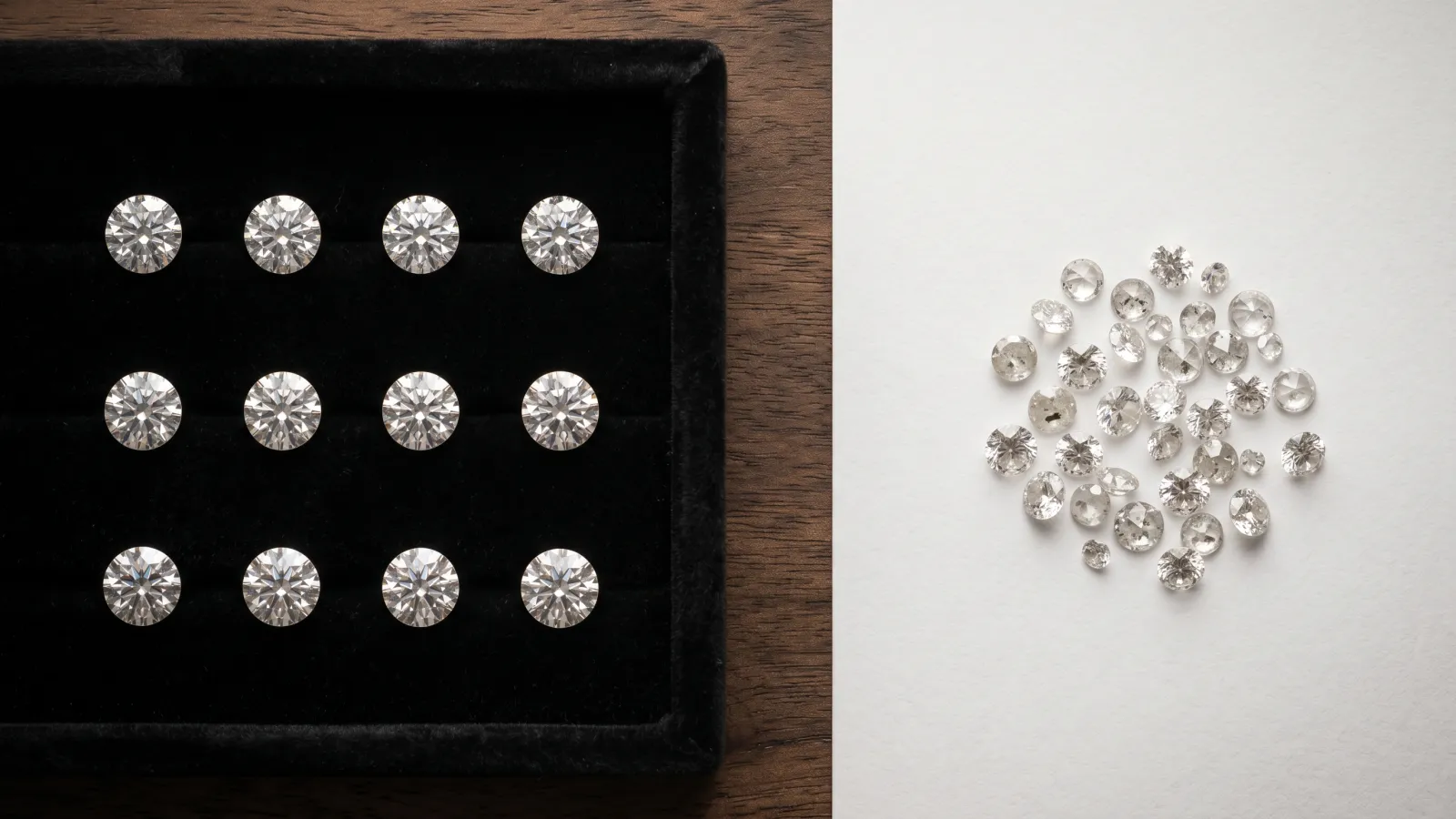
Curated sourcing adds a deliberate human checkpoint between production and listing. A curated wholesaler typically holds physical inventory rather than drop-shipping sight-unseen, works with a known and disclosed set of growers rather than buying opportunistically from whoever has the lowest price that week, and puts every incoming stone through a hand-inspection pass before it's eligible to be listed at all. Stones that don't clear that pass get repriced, returned to the grower, or held back rather than sold at face value against the certificate.
Three market conditions are pushing US wholesale buyers back toward the curated model in 2026:
- Just-in-time retail can't absorb quality mistakes. A retailer sourcing stone-by-stone against a specific customer order doesn't have slack in the calendar to discover a problem, return it, and re-source a replacement without blowing the appointment. One bad stone from a commodity channel can cost a retailer more in lost scheduling than the stone itself was worth.
- Customers are more informed than they used to be. Bridal shoppers increasingly walk in having already researched proportions, cut grades, and what "eye clean" is supposed to look like. A stone that reads fine on a certificate but underwhelms in hand loses the sale immediately, in front of the customer, which is the worst possible place for a quality gap to surface.
- Wholesale margins have compressed. When margins were wide, a retailer could absorb the occasional disappointing stone as a cost of doing business. With margins tighter across the trade, every return, every re-source, and every lost appointment has a harder-to-absorb effect on the bottom line.
None of this means commodity-sourced stones are inherently bad — some are perfectly good stones sold at a fair price with no inspection layer added. It means the buyer, not the wholesaler, is carrying the quality risk in that model. Curated sourcing shifts that risk to the wholesaler, in exchange for a modest premium.
Signs of curated quality vs. signs of commodity dumping
Most of the difference between the two models is visible before you ever place an order, if you know what to look for on a listing or ask the right question of a sales rep.
| Signs of curated quality | Signs of commodity dumping |
|---|---|
| Cut evaluated on actual proportions, not just the lab's grade label | Cut sold strictly against the certificate's grade, with no secondary check |
| Certificate cross-checked against the physical stone and its laser inscription | Certificate taken at face value with no physical match verification |
| Color and clarity reviewed under multiple lighting conditions | Color and clarity reviewed once, if at all, under whatever light is on hand |
| Video of the specific stone available on request, shot under neutral lighting | No video offered, or video shot under flattering studio lighting only |
| Fluorescence, phosphorescence, and any post-growth treatment disclosed upfront | Treatment and fluorescence status left off the listing entirely |
| Growth method identified clearly on the listing | Growth method unspecified or bundled into a generic "lab-grown" label |
| Physical inventory held and inspected before it's eligible to list | Inventory drop-shipped sight-unseen straight from the grower |
| Disclosed, ongoing relationship with a known, named grower | Sourced opportunistically from whichever grower has the lowest price that week |
| Clear return terms if a stone doesn't match its documentation or video | Return policy vague, restrictive, or effectively unenforceable |
| Return and reject rate openly shared when asked, usually low single digits | Return data not tracked, not shared, or waved off as "not applicable" |
No single row on this table is disqualifying on its own — a supplier might have a reasonable answer for any one gap. What matters is the pattern. A wholesaler landing consistently on the right side of most of these rows is running a curated operation; one landing consistently on the left is running a pass-through, whatever the marketing copy on their homepage says.
How certification accuracy varies across sourcing models
A grading certificate is a snapshot judgment made by a human grader at a specific point in time, applying a lab's internal standards to a specific stone. It's rigorous, but it isn't a guarantee that the physical stone in your hand today is exactly what the report describes — and how much daylight there is between the two depends heavily on which sourcing model the stone came through.
In a curated model, the certificate is a starting point, not an endpoint. The stone gets pulled against its report: the laser inscription on the girdle is checked against the certificate number, stated measurements are re-verified with calipers, and color and clarity are re-examined against the grade the report assigned. If something doesn't line up — a certificate number that's slightly off, a color call that looks generous, a clarity characteristic in a more visible position than the report implies — the stone gets flagged before it's ever offered for sale, not after a customer complains.
In a commodity pass-through model, that verification step is usually skipped entirely. The certificate is treated as sufficient documentation on its own, and the stone moves from grower to listing to buyer without anyone independently confirming that the physical stone and the paper match. Most of the time they do. The risk is in the stones that don't, and in a high-volume, low-margin channel there's little economic incentive for any single link in the chain to catch it.
Disclosure is the other half of certification accuracy, and it's where the gap is often widest. A full, honest listing discloses fluorescence and phosphorescence (strong fluorescence can create a hazy look under certain showroom lighting), growth method, and whether the stone has undergone any post-growth treatment to improve its color. None of these are automatically disqualifying — a well-disclosed treated stone priced accordingly can be a perfectly good buy. The problem is when they're left off the listing entirely, which shifts the discovery of that information to the customer, at the worst possible moment for a retailer's credibility.
A stone's memo and return history is a related, less obvious signal. A stone that has been sent out on memo repeatedly and returned each time has been through multiple hands, multiple environments, and multiple chances for handling damage — information a curated wholesaler tracks and either discloses or uses to retire the stone from active inventory. Commodity channels rarely track this at all.
Why cut quality is the most commonly cut corner in commodity lab-grown stock
Of all the places a commodity operation can save cost, cut quality is the one that gets compromised most often — and it's the one buyers are worst equipped to catch from a spec sheet alone.
The economics explain why. Cutting a piece of rough lab-grown material for maximum light performance almost always costs more carat weight than cutting it for maximum retained weight. A cutter working under volume pressure, paid or measured by carats produced rather than by finished stone performance, has every incentive to lean toward proportions that sit at the loose edge of a grade's tolerance rather than its ideal center — proportions that still earn the "Excellent" or "Very Good" label from a grading lab, but that sacrifice brilliance and fire to keep more weight in the stone. Because grading labs assess cut against a published range rather than a single ideal proportion, a stone cut specifically to maximize weight retention and a stone cut specifically to maximize optical performance can both land in the same cut grade bucket on paper. The certificate has no way to tell a buyer which philosophy the cutter followed. Only a physical evaluation — checking actual table percentage, crown and pavilion angles, and girdle thickness against the narrower range known to produce strong light return, not just the labs' wider acceptance range — reveals the difference.
Compounding the problem, most B2B marketplace filters are built around carat, color, clarity, and price, because those are the fields that are easy to standardize and search. Cut proportions are rarely a first-class filter, and even when they're listed, most buyers don't have a reference point for what a "good" table percentage or pavilion angle actually looks like in practice. That makes cut the easiest corner to cut, because it's the one least likely to get caught before purchase and least likely to be flagged by a buyer scanning a spec sheet rather than looking at the stone.
The result shows up at the counter, not on the invoice. A customer comparing two stones side by side under good light will notice a dead zone or a washed-out sparkle immediately, even if they can't articulate why in technical terms. That's the moment a retailer discovers that "Excellent cut" on a certificate and "actually cut well" are not the same claim.

How to evaluate a wholesale supplier's quality-control process
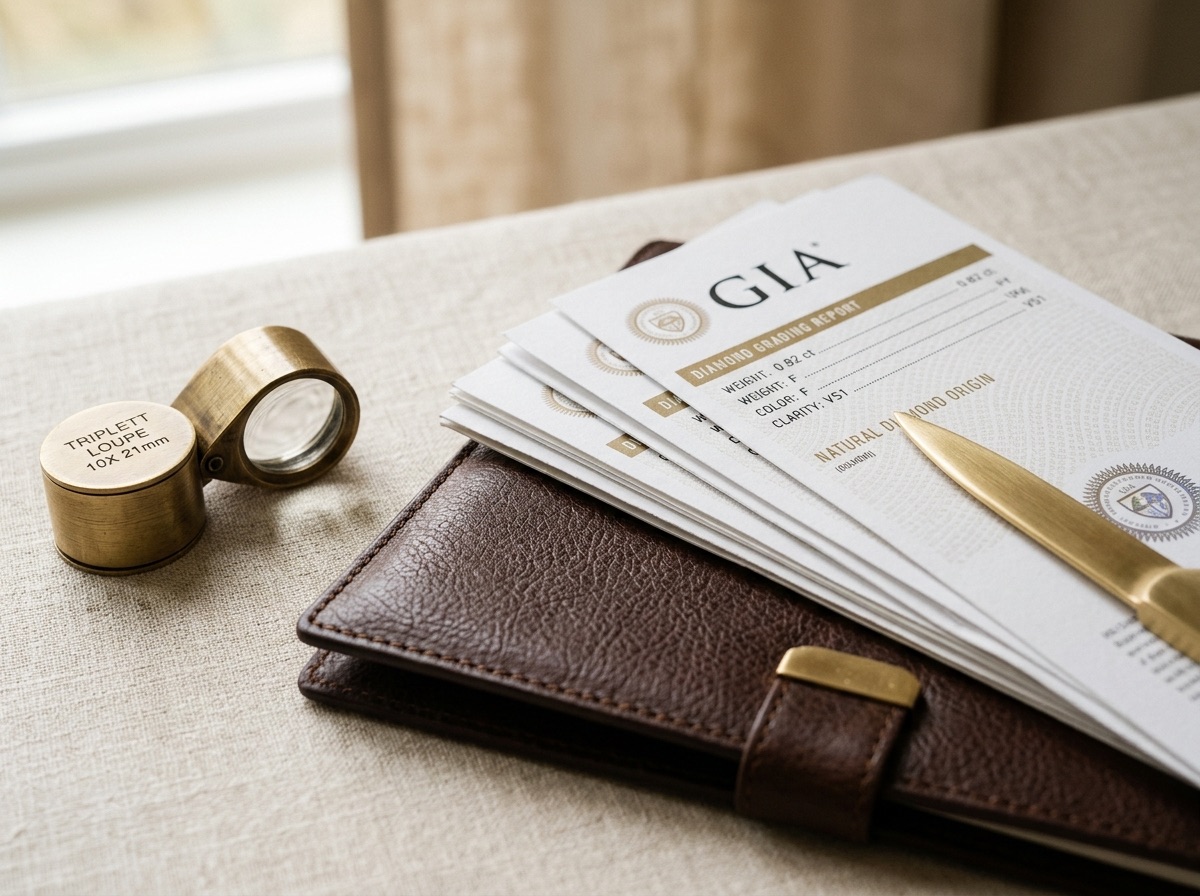
Before committing to a new wholesale relationship, a short set of direct questions will usually reveal which side of the curated-versus-commodity line a supplier actually sits on — regardless of how their marketing describes them.
"What's your return rate on stones that don't match specs?" A supplier who claims a zero return rate is either too new to have meaningful data, too small to have a representative sample, or not being straightforward with you. A healthy curated operation tracks this number and can share it without hesitation, usually landing in the low single digits.
"Do you physically hand-check every stone, or do you verify the certificate only?" These are two very different answers dressed up to sound similar. Verifying a certificate means confirming the paperwork exists and matches a stone number. Hand-checking means someone has physically examined the stone under controlled lighting and formed an independent judgment about its cut, color, and clarity beyond what the report states.
"Can I see video of this specific stone before I order it?" Yes should be the default, unhesitating answer. A supplier unwilling or unable to produce video of an individual stone on request is asking you to buy on faith in a market where that's no longer necessary.
"What's your relationship with the grower behind this stone?" Curated wholesalers can typically describe an ongoing, direct relationship with a specific, known grower. Commodity aggregators are often sourcing opportunistically from whichever grower has the most competitive price in a given week, with little continuity behind any individual listing.
"Is this stone drop-shipped, or is it in your physical inventory right now?" A supplier who holds and inspects physical inventory before listing is running a fundamentally different operation than one who lists a grower's catalog directly and only takes possession of a stone after you've already committed to buy it.
"What happens if the stone doesn't match the video or the certificate when it arrives?" Standard, unambiguous return terms should be the expected answer. Hesitation, vague policy language, or restocking fees buried in fine print are the signal to keep looking.
Pricing implications of curated vs. commodity sourcing
Curated wholesale does cost more per carat than commodity sourcing — typically a 3–8% premium on comparable stones. The relevant question for a buyer isn't whether that premium exists; it's whether it's cheaper or more expensive than the alternative once the full cost of a bad stone is counted, not just its sticker price.
Consider a retailer buying roughly $300,000 a year in wholesale lab-grown diamonds. Sourcing entirely through commodity channels at an average 5% discount looks like $15,000 a year in headline savings. But commodity channels typically carry a materially higher rate of stones that don't meet expectations once they're actually examined or shown to a customer — often in the 8–10% range. At $300 in shipping, appointment time, and handling per problem stone, that's $7,200–$9,000 a year in direct re-sourcing cost alone, before counting the sale itself.
The larger cost is usually the lost sale, not the returned stone. A customer who sees a disappointing stone at the counter doesn't typically wait around for a replacement to arrive — they leave, and often they buy somewhere else. Even one or two lost sales a month at a typical bridal ticket size can outweigh the entire annual "savings" from sourcing on price alone. Add in the harder-to-quantify cost of a customer who leaves with a lukewarm impression of the retailer's judgment, and the headline discount from commodity sourcing frequently turns into a net loss once the full cycle plays out over a year.
None of this means every commodity-sourced stone is a bad buy, or that every curated stone is worth an unlimited premium. It means the comparison shouldn't stop at the per-carat price. For a retailer running tight margins, the 3–8% curated premium functions less like an added cost and more like insurance against the much larger cost of a stone that fails at the point of sale.
Guru Diam's quality and sourcing approach

Guru Diam runs on the curated side of this line by design. Every stone in inventory goes through a hand-verification process before it's eligible to be listed:
- Certificate-to-stone match verified, including the laser inscription
- Physical inspection under multiple lighting conditions, not a single pass
- Cut proportions evaluated beyond the lab's grade label
- Color and clarity confirmed against the report, not assumed from it
- Video captured under neutral lighting conditions
- Listed with full disclosure — growth method, fluorescence, and any treatment history included
Guru Diam holds physical, on-hand inventory rather than drop-shipping sight-unseen from a grower, and both IGI and GIA certification are available depending on the stone. A stone that doesn't clear inspection doesn't get listed at face value against its certificate — it's repriced, held back, or returned rather than passed along as-is.
The goal of this process isn't to eliminate every possible edge case; it's to make sure that what a jeweler sees on a video call or receives on memo is what they can expect to show a customer with confidence, without needing to run their own independent inspection on top of ours.
Buying checklist and red flags
Between the questions above and the comparison table, a wholesale buyer has most of what's needed to sort a curated supplier from a commodity one. Distilled down, here's the short version to keep on hand when evaluating a new relationship.
Green flags — answer "yes" to all of these and you're likely dealing with a curated wholesaler:
- Every stone hand-inspected before it's listed, not just certificate-checked
- Physical inventory held and available for inspection, not drop-shipped sight-unseen
- Video of the specific stone available on request
- Certificate-to-stone match, including laser inscription, verified before listing
- Standard, clearly stated return terms if a stone doesn't match its documentation
- Transparent, ongoing relationships with known, named growers
Red flags — any one of these is worth a direct follow-up question before you order:
- "We list what the certificate says" offered as the entire quality-control answer
- No video available, or only pre-shot marketing photos under favorable lighting
- Reluctance or vague answers when asked about return or reject rates
- Growth method, fluorescence, or treatment history absent from the listing
- Sourcing that changes grower-to-grower based purely on that week's lowest price
- Return policy that's restrictive, fee-heavy, or requires the buyer to prove a defect
If a supplier can only answer "we list what the cert says" when asked how they screen inventory, that's a commodity pass-through — whatever the name on the invoice.
Frequently Asked Questions
Q: What does "curated lab-grown diamond wholesale" actually mean?
It means every stone has been individually inspected, verified against its own grading report, and documented — video included — before it's offered to a retail buyer, rather than being listed on the strength of its certificate specs alone. The certificate is treated as a starting point for verification, not the entire quality check.
Q: Are online B2B diamond marketplaces reliable?
It varies widely by platform and by seller. Some marketplaces do apply meaningful screening; many function as pass-through aggregators that list stones directly from growers with no independent verification layer. Unless a marketplace explicitly states it hand-inspects inventory before listing, assume the retailer is carrying the quality risk, not the platform.
Q: How much more expensive is curated wholesale than commodity sourcing?
Typically a 3–8% premium on comparable stones. Over a year of ordering, that premium is usually smaller than the combined cost of returns, re-sourcing, and lost sales that tends to accompany unscreened commodity inventory, which is why many retailers treat it as a cost-saving choice rather than a markup.
Q: What's the difference between "Excellent" cut grades across different stones?
"Excellent" describes a range of proportions, not one fixed set of measurements. Two stones can both carry an Excellent cut grade from the same lab and still differ noticeably in brilliance and fire once you compare them side by side, because one sits closer to the ideal center of that range and the other sits closer to its loose edge. A physical cut evaluation beyond the certificate is the only way to tell which is which before you buy.
Q: Can I return a commodity-sourced diamond if it doesn't match the listing photo?
Sometimes, but terms vary widely and are worth confirming in writing before ordering. Some commodity sellers offer straightforward returns; others apply restocking fees, short return windows, or require the buyer to cover return shipping and prove a specific defect. A curated wholesaler's return terms are typically simpler because fewer stones need to be returned in the first place.
Q: What percentage of lab-grown diamonds have undisclosed post-growth treatments?
A small but non-zero percentage across the market. The risk is meaningfully higher when buying directly from an unfamiliar grower or an aggregator with no independent inspection step, since there's no intermediate checkpoint to catch or disclose treatment history before the stone reaches a retailer.